

2024 was a good year for quality of life in Spain: the official INE index rose to 101.47 points and 72.6% of Spaniards report high or very high satisfaction with their lives. But which are really the best cities to live in Spain? And above all, who is rising and who is falling? In this analysis I compare the various sources: the OCU survey, run by Spain’s main consumer association, the INE’s Multidimensional Quality of Life Indicator (IMCV) and the MWCC ranking built on Numbeo data. First the national picture, then the city ranking, with a few surprises along the way.
Part 1: quality of life in Spain is growing again
According to INE, the national statistics institute, in 2024 the IMCV reached 101.47 points (base 100 = year 2008), up from 101.20 in 2023 and rising for the second consecutive year from the post-pandemic low of 2022 (101.14). An honest reading, however, requires one caveat: the all-time peak is still the pre-Covid figure of 2019, at 101.91. Spain is climbing back, but it has not completed the recovery yet.
Looking at the nine dimensions of the index, six improved:
- health (from 101.86 to 103.29, the biggest gain),
- work (102.34),
- education (110.11, the highest-scoring dimension of all), material living conditions, safety and environment.
- Bucking the trend, two items that will get people talking: leisure and social relationships (93.90, the lowest score and falling) and overall life satisfaction (102.70).
Translation: Spaniards are objectively better off, but they socialise less — and they notice it.
The regional ranking: the North wins
At territorial level the North-South divide is stark. Navarre, La Rioja and the Basque Country lead the way, while at the bottom we find the Canary Islands, Andalusia and Galicia, along with the autonomous cities of Ceuta and Melilla. The biggest improvements over 2023, however, come from the islands: the Balearics (+0.77 points) and the Canaries (+0.65).
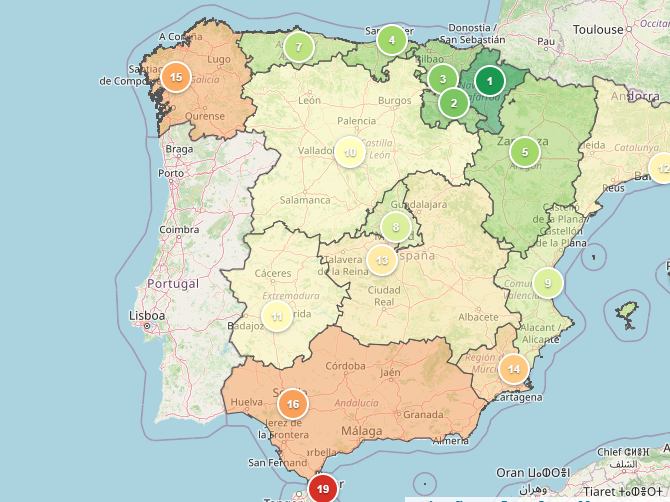
Quality of life by autonomous community, IMCV 2024
Source: INE, Indicador Multidimensional de Calidad de Vida (base 2008 = 100). Click on the headers to sort.
| # | Autonomous community | IMCV 2024 | Gap vs average |
|---|---|---|---|
| 1 | Navarre | 105.19 | +3.72 |
| 2 | La Rioja | 103.91 | +2.44 |
| 3 | Basque Country | 103.74 | +2.27 |
| 4 | Cantabria | 103.42 | +1.95 |
| 5 | Aragon | 103.39 | +1.92 |
| 6 | Balearic Islands | 103.13 | +1.66 |
| 7 | Asturias | 102.90 | +1.43 |
| 8 | Community of Madrid | 102.28 | +0.81 |
| 9 | Valencian Community | 102.27 | +0.80 |
| 10 | Castile and León | 101.52 | +0.05 |
| — | National average | 101.47 | = |
| 11 | Extremadura | 101.43 | −0.04 |
| 12 | Catalonia | 101.31 | −0.16 |
| 13 | Castilla-La Mancha | 101.11 | −0.36 |
| 14 | Murcia | 100.36 | −1.11 |
| 15 | Galicia | 99.67 | −1.80 |
| 16 | Andalusia | 99.54 | −1.93 |
| 17 | Canary Islands | 99.38 | −2.09 |
| 18 | Melilla | 98.95 | −2.52 |
| 19 | Ceuta | 97.91 | −3.56 |
Navarre comes first in health, leisure, environment and overall satisfaction; the Basque Country in material conditions and education; the Balearics in work; Asturias in safety. Biggest improvements from 2023 to 2024: the Balearics (+0.77) and the Canaries (+0.65).
Part 2: the best cities to live in Spain
Now on to the cities. The survey closest to Italy’s Sole 24 Ore ranking is the one run by the OCU: nearly 3,000 residents of the 15 largest cities rated 10 criteria, from cost of living to safety, from healthcare to mobility. The verdict overturns expectations: the winner is Vigo, in Galicia, followed by Zaragoza, Bilbao, Valladolid and Córdoba. Madrid and Barcelona come last, penalised by cost of living, house prices, pollution and perceived crime. A note on transparency: the OCU survey dates back to 2020-2021 but remains the reference still cited today by the Spanish media, which in re-running it indicate a top 7 with Vigo always first, followed by Gijón, Bilbao, Valladolid, Zaragoza, Málaga and Valencia.
For a broader and more up-to-date snapshot I also rely on the MWCC ranking based on Numbeo data, which analysed 62 Spanish cities (the 50 provincial capitals, the two autonomous cities and ten significant municipalities), with an overall index computable for 31 of them. Here too the script repeats itself: the mid-sized cities of the North come out on top.
Top 20 Spanish cities by quality of life
Source: MWCC on Numbeo data (62 cities analysed); strengths integrated with OCU and IESE Cities in Motion 2025. Click on the headers to sort.
| # | City | Autonomous community | Strengths |
|---|---|---|---|
| 1 | Pamplona | Navarre | 1st for purchasing power and environment, 3rd for safety |
| 2 | Logroño | La Rioja | Balanced across all indicators, contained costs |
| 3 | Oviedo | Asturias | 2nd for healthcare, 3rd for housing affordability |
| 4 | Santander | Cantabria | Environmental quality, a city built to human scale |
| 5 | Burgos | Castile and León | 3rd for lowest cost of living |
| 6 | Valencia | Valencian Comm. | Best large city; 4th in the world for Numbeo (2023) |
| 7 | Castelló de la Plana | Valencian Comm. | Contained costs, the sea and a mid-size scale |
| 8 | Cartagena | Murcia | Cheapest city in Spain, 3rd for healthcare |
| 9 | Vigo | Galicia | 1st in the OCU ranking: safety, cleanliness, education |
| 10 | León | Castile and León | 3rd for purchasing power |
| 11 | Madrid | Comm. of Madrid | 2nd for purchasing power, engine of the labour market |
| 12 | Salamanca | Castile and León | University city with affordable costs |
| 13 | Girona | Catalonia | A quality alternative to the Barcelona area |
| 14 | Córdoba | Andalusia | OCU top 5: well-rated healthcare and affordable housing |
| 15 | Málaga | Andalusia | Among the world’s top 100 smart cities (IESE 2025) |
| 16 | Zaragoza | Aragon | 2nd in the OCU ranking, excellent mobility |
| 17 | Gijón | Asturias | 2nd for perceived safety according to OCU |
| 18 | A Coruña | Galicia | Atlantic quality of life, mid-size scale |
| 19 | Valladolid | Castile and León | 2nd safest city (MWCC), OCU top 5, low costs |
| 20 | Tarragona | Catalonia | Mediterranean climate, lower costs than Barcelona |
The MWCC ranking orders cities by Numbeo synthetic index (purchasing power and cost of living, access to housing, environment, safety, healthcare, traffic). Positions 21–31: Alicante, Granada, Bilbao, Seville, Las Palmas, Palma de Mallorca, Santa Cruz de Tenerife, Getafe, Murcia, Barcelona, Almería.
Who’s rising and who’s falling
Valencia is the real star of the moment. Best large Spanish city according to MWCC (6th overall), and in 2023 Numbeo placed it as high as 4th in the world. Current data confirms it: in July 2026 its quality of life index is 182.5, the highest among the big Spanish cities, ahead of Málaga (177.2) and Madrid (176.0).
Barcelona is the great invalid: 30th out of 31 in the MWCC ranking, last alongside Madrid in the OCU survey, and with a current Numbeo index of 147.4, weighed down by perceived safety (47.9) and pollution (62.8). The paradox is that internationally it remains a standout: 34th in the world in the IESE Cities in Motion Index 2025, which measures 183 cities as hubs of innovation.
Madrid lives the same paradox in amplified form: marked down by its own residents on costs and environment, it is nonetheless 2nd in Spain for purchasing power, 24th smart city in the world according to IESE and 7th globally for mobility and transport. Málaga, meanwhile, is the climber: 98th in the IESE index, driven by technology and tourism, with a Numbeo index that today places it second among the large cities. Finally, keep an eye on Vigo and Pamplona: they don’t appear in the international rankings, but when it is the residents who vote, they win every time.
What the comparison with Italy tells us
The Spanish picture looks strikingly like the Italian one photographed every year by Sole 24 Ore: quality of life is improving at national level, but the podium does not belong to the big capitals — it belongs to the mid-sized cities of the North, where safety, services and cost of living strike the best balance.
Big cities attract jobs and talent but “pay” for it in housing, pollution and safety. And Spain as a whole remains a place where life is good: the 2026 Numbeo index puts it in the world’s top 20 for quality of life. The INE data for 2025, expected in autumn 2026, will tell us whether the pre-Covid 2019 peak has finally been overtaken.
Leave a Reply