
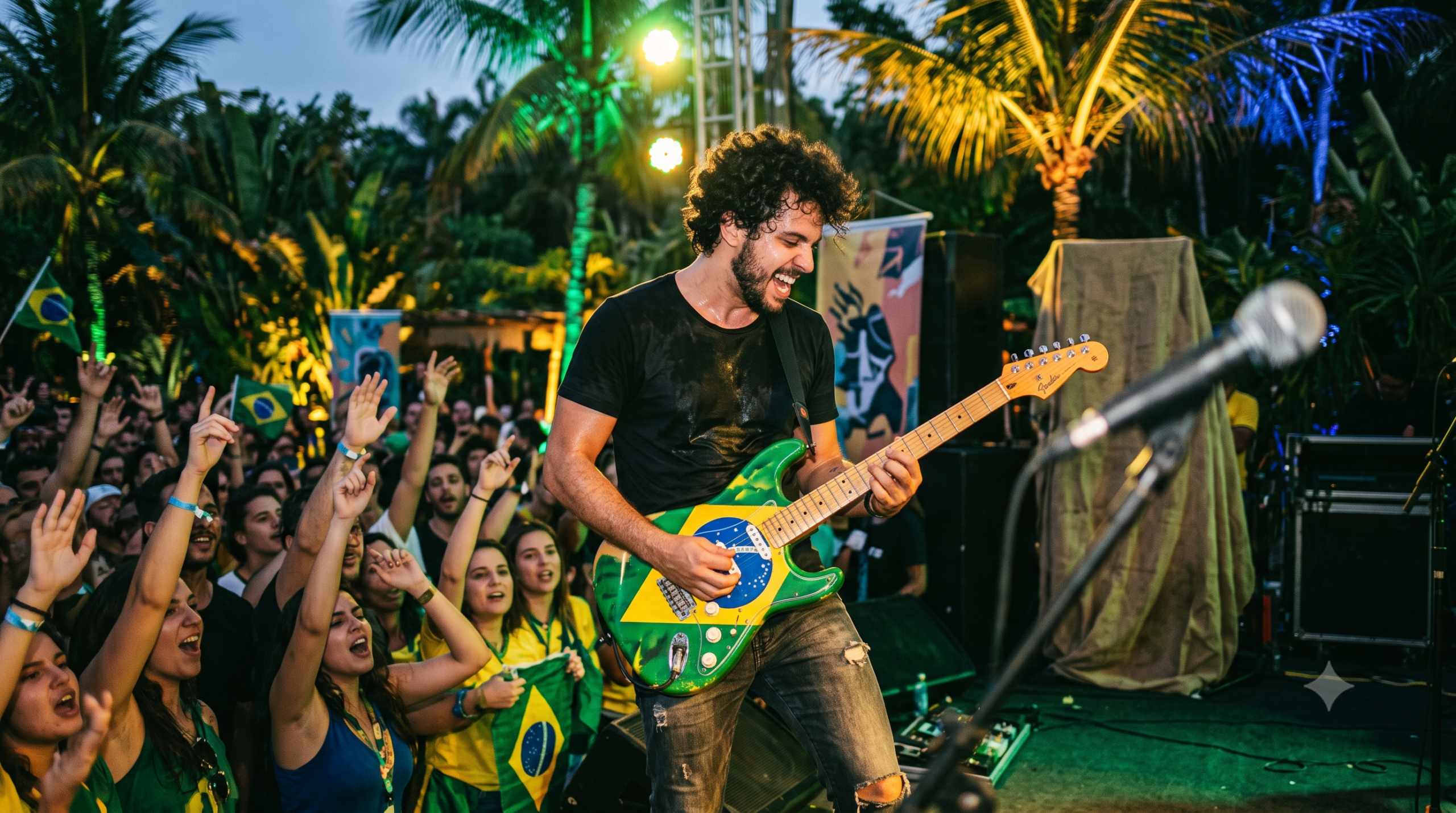
The Brazilian rock scene is perhaps the least known — and most surprising — chapter in the whole history of Latin American rock. It was born in a country with a musical tradition so rich and layered that it seems almost impermeable to the electric guitar: samba, bossa nova, MPB, baião. And yet rock in Portuguese not only survived this context, it produced some of the most original albums of the last fifty years.
This ranking does not select the most famous bands or the best-selling records. It selects the 10 artists who best tell the entire trajectory of Brazilian rock: from its origins in the ’70s, through the explosion of the ’80s, all the way to Sepultura’s global metal and the invention of manguebeat. One record for every season, a story for every vinyl.
If you’re just starting to explore Latin American rock, I recommend you read first
👉Article #01: From Patagonia to Mexico
👉Article #02: The 10 Argentine rock bands
The roots of Brazilian rock: from Tropicalismo to BRock
To understand Brazilian rock you have to start with a movement that isn’t strictly rock: Tropicalismo. Between 1967 and 1968, Caetano Veloso, Gilberto Gil and Os Mutantes blended bossa nova, samba, psychedelia and electric rock into a cultural manifesto that blew open the debate on Brazilian musical identity. That bold fusion of local roots and international sound would become the DNA of everything that came afterwards.
The real leap, however, happens in the ’80s, with what Brazilian critics call BRock: a wave of bands, all active at the same time between 1982 and 1986, that brought Portuguese-language rock into the national mainstream. Legião Urbana, Titãs, Barão Vermelho, Os Paralamas do Sucesso, Capital Inicial: they all came out in the same period, they influenced one another, and together they created what many consider the golden decade of Brazilian rock.
Rock em português vs rock en español: two different souls
The difference between Brazilian rock and Spanish-American rock is not just linguistic. It is structural.
Rock in Spanish (Argentine rock first and foremost) tends towards lyrical density and political weight: it is often erudite, literary music, built on lyrics that demand attention. Spinetta writes poetry; Indio Solari quotes Borges.
Brazilian rock, on the other hand, carries within itself rhythm as a substrate: it is almost impossible to play in Portuguese without something of samba or maracatu or baião working its way into the structure of the song, even when the track is clearly rock. This rhythmic permeability is what makes it immediately recognisable and impossible to replicate.
📌 In short: Argentine rock starts from the word; Brazilian rock starts from the rhythm. Both arrive at the same emotional power, but by completely different routes.
The ranking: the 10 essential artists of Brazilian rock
From #10 to #1, with extended reasoning and a key track for every record.
#10 – Engenheiros do Hawaii · Alternative rock · Folk rock
Porto Alegre is far from São Paulo and from Brasília, geographically and culturally. Engenheiros do Hawaii bring a voice from the South into Brazilian rock: more melancholic, more literary, with influences ranging from North American folk to British progressive. Humberto Gessinger writes lyrics of unusual density for ’80s rock.
Their debut proves that BRock was not only a phenomenon of the big central-southern metropolises, and that rock in Portuguese could be introspective and geographically peripheral without losing any of its force. An album that still surprises today for the maturity of its writing.
🎵 Key track: «Toda forma de poder» (1986)
📌 For fans of: R.E.M., The Smiths — but with a uniquely Brazilian soul.
#9 Raimundos · Forropunk · Punk rock
Raimundos literally invent a genre: forropunk. They take forró — a traditional rhythm from the Brazilian Northeast, generally associated with rural popular music — and blow it up inside a punk structure. The result is chaotic, original, irresistible.
The historical importance of Lavagem Cerebral goes beyond its intrinsic musical value: it proves that Brazilian rock doesn’t have to look only north (USA, UK) or south (Argentina) to renew itself. It can look inside itself, at its own regional roots, and find explosive material. This lesson would influence all of Brazilian alternative rock in the ’90s and 2000s.
🎵 Key track: «Mulher de Fases» (1994)
📌 For fans of: Offspring, NOFX — but with tuba bass and sanfona.
#8 Sepultura · Groove metal · Thrash · Brazilian indigenous music
Sepultura are the proof that Brazilian rock can be as heavy as anything else produced anywhere in the world. Formed in Belo Horizonte in 1984 by brothers Max and Igor Cavalera — together with Andreas Kisser and Paulo Jr. — through the ’80s and ’90s they built one of the most important catalogues in the history of world metal.
Roots is their absolute masterpiece, and probably the most Brazilian album they ever recorded. To make it, Sepultura travelled to the reservation of the Xavante people, in Mato Grosso, and recorded with the local indigenous musicians: the result is a record in which thrash metal converses with tribal percussion, ritual chants and ancestral rhythms. An experiment that never sounds like exotic curiosity, but like something urgent and necessary.
It is also the last album with Max Cavalera, who would leave the band shortly afterwards. His musical and cultural legacy has been unmatched.
🎵 Key track: «Roots Bloody Roots» (1996) · «Ratamahatta» with Carlinhos Brown (1996)
📌 For fans of: Pantera, Korn but with their heart in Mato Grosso.
#7 Capital Inicial · Post-punk · New wave
Brasília is the city of BRock: Capital Inicial, Legião Urbana and Plebe Rude were all born in the same scene, they know each other, they influence each other, they share tiny stages. Capital Inicial formed from the ashes of Aborto Elétrico, Renato Russo’s first band, and brought into Brazilian rock the sound closest to British post-punk and new wave.
Dinho Ouro Preto on vocals has an intense stage presence and an unmistakable melodic phrasing. Independência is their most cohesive and representative album: cutting synths, fast guitars, lyrics that speak of identity and freedom in a country that had just emerged from dictatorship. An essential sonic document for understanding the cultural climate of mid-’80s Brazil.
🎵 Key track: «Independência» (1987) · «Fogo» (1987)
📌 For fans of: The Cure, Depeche Mode in Portuguese and with more warmth.
#6 Chico Science & Nação Zumbi · Manguebeat · Funk · Maracatu · Rock
Francisco de Assis França (Chico Science) had four years to change Brazilian music. He died in a car crash in 1997, aged 30. But those four years were enough.
Manguebeat was born in Recife, in the Brazilian Northeast, a city Chico Science described as «a cybernetic mud hole»: mud and future. With Nação Zumbi he mixes electric funk, distorted rock and maracatu (the Afro-Brazilian percussion of the Northeastern communities) into a sound that had no precedent. Da Lama ao Caos is still today one of the most original albums ever produced in Latin America, and its impact on Brazilian rock in the ’90s is comparable to that of Nevermind on American rock.
🎵 Key track: «A Cidade» (1994) · «Sangue de Bairro» (1994)
📌 For fans of: Rage Against the Machine, Red Hot Chili Peppers — but with Brazil’s African roots inside every beat.
#5 Os Paralamas do Sucesso · New wave · Reggae · MPB
Os Paralamas do Sucesso are the most eclectic band of BRock. Herbert Vianna on guitar has impeccable taste for pop melody; Bi Ribeiro on bass brings a never-intrusive reggae influence to every record; João Barone on drums is among the most solid of his generation. Together, they produce a rock that cannot be precisely labelled, and that is their strength.
Selvagem? is the album of maturity: Alagados is perhaps the finest socially engaged song in all of Brazilian rock: it speaks of the communities of Morro do Alemão in Rio de Janeiro with a delicacy that no one else had managed to find. Reggae meets MPB, rock almost becomes folk, and the result is music that never sounds like a compromise but always like an authentic synthesis.
🎵 Key track: «Alagados» (1986) · «Vital e sua Moto» (1984)
📌 For fans of: UB40, The Police but with the warmth and complexity of Brazil.
#4 Titãs · Post-punk · Hardcore · New wave
There’s a simple way to describe Cabeça Dinossauro: it is the most important punk album in the history of Brazilian rock. Titãs were born out of an almost anarchic idea. Nine musicians, all singers, all co-writers, no declared leader, and they use this horizontal structure to produce a record that sounds like one continuous assault.
The songs are short, aggressive, loaded with black irony: Polícia (the most famous track) is built on a single repeated question («quem vai te proteger?») which in 1986, with Brazil having just emerged from dictatorship, landed like a bomb. Bichos Escrotos, Homem Primata: the whole record is run through with this tension between corrosive humour and genuine rage.
It’s an album that hasn’t aged a single day. If anything: it sounds even more urgent today than it did in 1986.
🎵 Key track: «Polícia» (1986) · «Bichos Escrotos» (1986)
📌 For fans of: The Clash, Dead Kennedys but with the collective madness of nine Brazilian brains.
#3 Raul Seixas · Rock · Baião · Blues · Counterculture
Raul Santos Seixas was born in Salvador, Bahia, in 1945. He comes to rock music carrying all the baggage of his homeland (baião, Afro-Brazilian mysticism, the oral tradition of the Northeast) and pours it into a distorted electric guitar. The result is something that had no precedent in any country in the world.
Raul Seixas is often called «the father of Brazilian rock»: not because he was the first to play rock in Brazil, but because he was the first to create something irreducibly Brazilian inside rock. Krig-Ha, Bandolo! — the title is a Tarzan expression meaning «beware, danger» — contains Ouro de Tolo, probably the most important song in the history of Brazilian rock: a critique of materialism and of the bourgeois dream that in 1973, in the middle of the military dictatorship, was an act of extraordinary courage.
Raul Seixas wrote many of the lyrics from this period with Paulo Coelho (yes, the one who wrote The Alchemist ) in a creative partnership that is one of the most singular episodes of twentieth-century Brazilian culture. He died in 1989 from complications related to alcoholism. He was 44.
🎵 Key track: «Ouro de Tolo» (1973) · «Al Capone» (1973)
📌 For fans of: Bob Dylan, Frank Zappa but with the soul of the Brazilian Northeast and a wizard’s hat.
#2 Barão Vermelho · Rock · Blues rock
Cazuza — stage name of Agenor de Miranda Araújo Neto — is the most charismatic frontman in the history of Brazilian rock. Son of a music producer, a rebel by nature and by choice, with Barão Vermelho he builds one of the most viscerally rock projects of the ’80s São Paulo scene.
The band’s third album is also the most mature: raw blues, lyrics about love and loss, a production that still sounds fresh. Cazuza died of AIDS-related complications in 1990, aged just 32, becoming, despite himself, the symbol of an entire generation that was discovering its own limits. His legacy in Brazilian rock is priceless.
🎵 Key track: «Pro dia nascer feliz» (1983) · «Bete Balanço» (1984)
📌 For fans of: Rolling Stones, David Bowie with the drama of the tropics.
#1 Legião Urbana · Rock · New wave · Post-punk
There’s no argument to be had. Legião Urbana’s Dois is the greatest album in the history of Brazilian rock. Perhaps the greatest Portuguese-language rock album ever made.
Renato Russo (Renato Manfredini Jr., born in Rio de Janeiro in 1960 and raised in Brasília) is one of the most extraordinary songwriters Latin America has ever produced. Legião Urbana’s second album came out in 1986 and contains, in 43 minutes, three songs that on their own would justify a place in the history of world music: Tempo Perdido, Eduardo e Mônica and Índios.
Tempo Perdido speaks of youth and regret with a melodic grace that still tightens the heart. Eduardo e Mônica is the most beloved love story of Brazilian rock: two completely different people who fall in love. Simple, human, perfect. Índios is an indictment of the extermination of indigenous peoples that still sounds like a scream.
Renato Russo died of AIDS-related complications in 1996, aged 36. Dois is the record with which Brazil mourns its dead, celebrates its loves and remembers who it was before becoming what it is. It isn’t just Brazilian rock: it’s a piece of national identity.
🎵 Key track: «Tempo Perdido» · «Eduardo e Mônica» · «Índios» (1986)
📌 Where to start: listen to «Eduardo e Mônica». If it doesn’t change something inside you, try again in a few years.
Why Brazilian rock is a universe of its own
These ten albums cover twenty years of history and at least as many different genres. And yet they all have something in common: they sound irreducibly Brazilian. Brazilian rock was never an imitation of the Anglo-Saxon kind, even when it borrowed its instruments and structures. It always found a way to incorporate something local (a rhythm, an emotion, a landscape) that made it unmistakable.
This is why it’s worth getting to know even if you don’t speak Portuguese, even if you don’t know the geography of São Paulo or the stories of Brasília. The music of Raul Seixas, of Renato Russo, of Chico Science needs no translation: it arrives directly.
→ Next article: Rock and dictatorships — when playing was a political act
Leave a Reply