
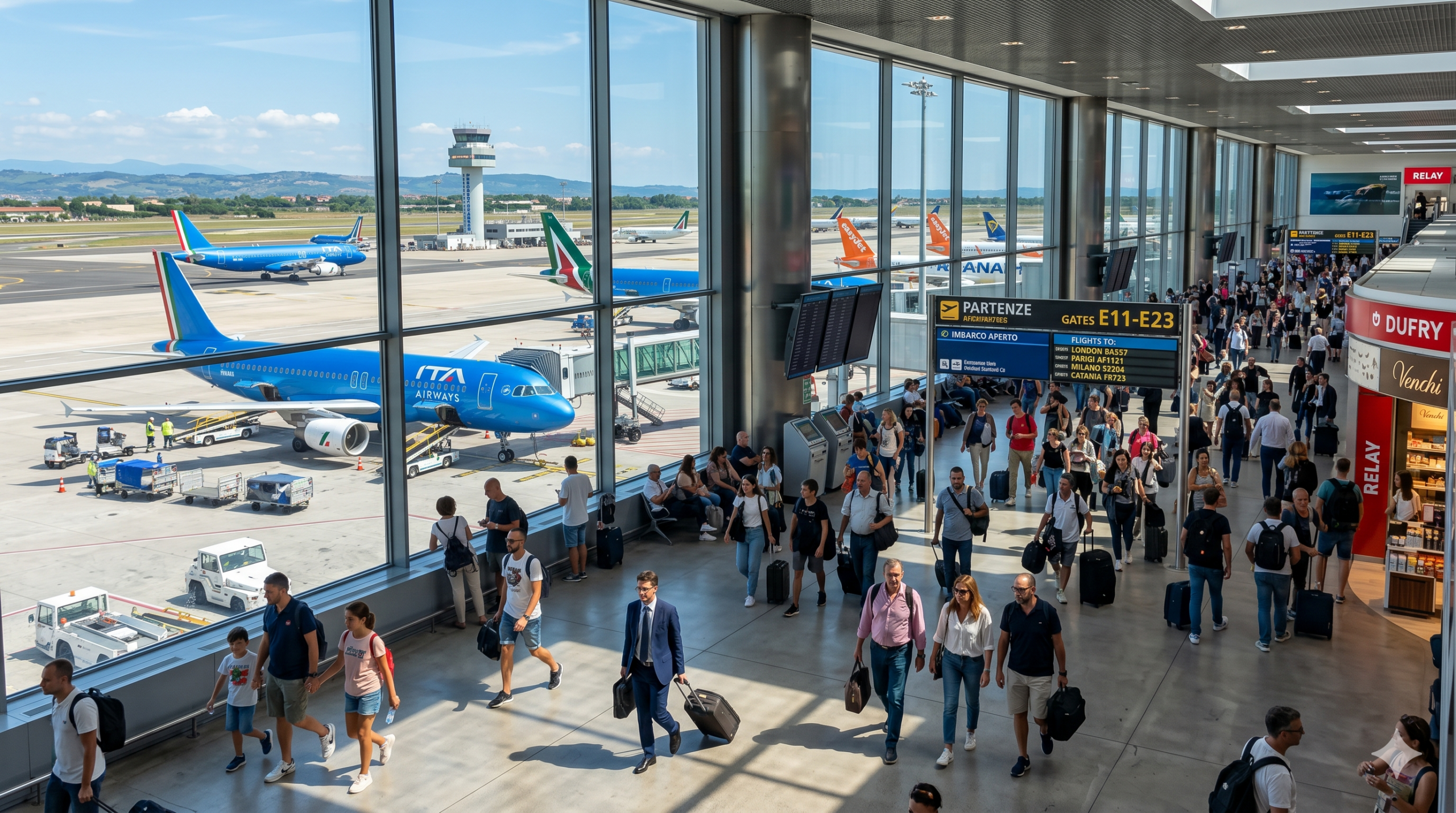
2025 was a record year for air transport. Globally, passengers passed 9.8 billion, while in Italy airports reached 229.7 million travellers. But which are really the busiest airports of 2025? And above all, who climbed the ranking and who fell? In this Rank&Roll analysis we compare the official ACI World and Assaeroporti figures, splitting the article into two parts: first the world top 20, then the Italian picture with the surprises of the Bel Paese.
Part 1: the busiest airports in the world in 2025
According to the preliminary data published in April 2026 by Airports Council International (ACI) World, in 2025 global traffic reached 9.8 billion passengers, up 3.6% on 2024 and 7.3% on 2019. It seemed impossible after the pandemic, and yet the sector has not only recovered the ground it lost, it has also passed pre-Covid levels.
Behind the overall numbers, however, lie some interesting regional dynamics. Asia-Pacific and the Middle East keep gaining ground, Europe and North America are approaching saturation, while geopolitical conflicts are redrawing traditional traffic flows.
World top 10: Atlanta dominates, Tokyo on the podium
Atlanta remains firmly on top for the 27th consecutive year (with the sole exception of 2020). Hartsfield-Jackson Atlanta International Airport handled 106.3 million passengers in 2025, down 1.6% on 2024 and almost 4% on 2019. Dubai confirms its stable second place and keeps its crown as the world’s busiest airport for international traffic.
The real news on the podium is Tokyo Haneda, which overtakes Dallas/Fort Worth thanks to the strong recovery of traffic in Asia-Pacific. Shanghai Pudong is the big story of the top 10: it climbs from 10th to 5th place, driven by the recovery of international traffic, the easing of visa policies and the expansion of connections.
World top 20: the full ranking
Here is the full ranking according to ACI World and official airport statistics:
| # | Airport | Country | Passengers 2025 | Change vs 2024 |
|---|---|---|---|---|
| 1 | 🇺🇸Atlanta Hartsfield-Jackson ATL | United States | 106,302,208 | −1.6% |
| 2 | 🇦🇪Dubai International DXB | United Arab Emirates | 95,192,160 | +3.1% |
| 3 | 🇯🇵Tokyo Haneda HND | Japan | 91,679,814 | +6.7% |
| 4 | 🇺🇸Dallas/Fort Worth DFW | United States | 85,660,127 | −2.5% |
| 5 | 🇨🇳Shanghai Pudong PVG | China | 84,994,227 | +10.7% |
| 6 | 🇺🇸Chicago O’Hare ORD | United States | 84,814,099 | +6.0% |
| 7 | 🇬🇧London Heathrow LHR | United Kingdom | 84,482,126 | +0.7% |
| 8 | 🇹🇷Istanbul IST | Türkiye | 84,437,710 | +5.5% |
| 9 | 🇨🇳Guangzhou Baiyun CAN | China | 83,582,952 | +9.5% |
| 10 | 🇺🇸Denver DEN | United States | 82,427,962 | +0.1% |
| 11 | 🇮🇳Delhi Indira Gandhi DEL | India | 79,259,890 | +1.8% |
| 12 | 🇰🇷Seoul Incheon ICN | South Korea | 74,071,475 | +4.0% |
| 13 | 🇺🇸Los Angeles LAX | United States | 73,709,594 | −3.8% |
| 14 | 🇫🇷Paris Charles de Gaulle CDG | France | 72,029,407 | +2.5% |
| 15 | 🇨🇳Beijing Capital PEK | China | 70,742,712 | +5.0% |
| 16 | 🇸🇬Singapore Changi SIN | Singapore | 69,980,000 | +3.4% |
| 17 | 🇳🇱Amsterdam Schiphol AMS | Netherlands | 68,800,000 | +3.0% |
| 18 | 🇪🇸Madrid Barajas MAD | Spain | 68,179,054 | +3.1% |
| 19 | 🇨🇳Shenzhen Bao’an SZX | China | 66,485,213 | +8.1% |
| 20 | 🇲🇾Kuala Lumpur KUL | Malaysia | 63,300,000 | +11.0% |
Who’s rising and who’s falling globally
At this point the dynamics become clear. First of all, Asia-Pacific is the real engine of growth: as well as Shanghai Pudong, Guangzhou Baiyun has also climbed back to 9th place, after being 57th as recently as 2022. Moreover, Beijing Capital has returned to the top 20 after a long absence, and Kuala Lumpur records the highest growth in the ranking at +11%.
In Europe, by contrast, the picture is less exciting. London Heathrow grows by barely 0.7%, while Paris Charles de Gaulle and other major European hubs are operating at the limit of their capacity, with reduced room for growth without new infrastructure investment. Frankfurt, which was in the top 20 in 2024, dropped out of the ranking in 2025.
In the United States the picture is mixed. On the one hand Chicago O’Hare grows by 6% and overtakes Heathrow. On the other, Dallas/Fort Worth, Denver, Atlanta and above all Los Angeles (−3.8%) post negative or flat changes, a sign that the American domestic market is now mature.
Finally, Istanbul continues its quiet climb. The Turkish hub has gone from 28th place in 2019 to 8th in 2025, exploiting its geographical position and the expansion of Turkish Airlines. A perfect example of how geopolitics is redrawing global air routes.
Part 2: the busiest airports in Italy in 2025
Now on to Italy, which in 2025 had its best year ever. According to Assaeroporti, Italian airports recorded 229.7 million passengers in 2025, an increase of 5% on 2024. The cargo segment also grew, passing 1.2 million tonnes.
In particular, international traffic reached 157.2 million passengers (68% of the total), up 8% on 2024, while domestic traffic remained stable at 72.5 million. Poland, overtaking the United States, entered the top 5 destination countries with growth of 32%.
Italian top 10: Fiumicino breaks through 50 million
The symbolic figure of 2025 is just one: for the first time in its history, Rome Fiumicino passed 50 million passengers. The Leonardo da Vinci airport closed 2025 with 51,306,744 passengers, while Milan Malpensa recorded 31,385,585 travellers and Bergamo Orio al Serio 16,937,976. In short, two historic firsts in the same year: Fiumicino above 50 million, Malpensa above 30.
One detail not to be missed: Italy’s 5th airport is not in the North — it is Catania, which has overtaken Venice, Bologna and even Milan Linate. What’s more, as many as four southern airports are in the top 10 (Naples, Catania, Palermo and Bari), which together exceed 42 million passengers: more than Malpensa on its own.
Italian top 20: the full ranking
Here is the full ranking according to Assaeroporti and the airport operators’ announcements:
| # | Airport | Region | Passengers 2025 | Change vs 2024 |
|---|---|---|---|---|
| 1 | Rome Fiumicino FCO | Lazio | 51,306,744 | +4.3% |
| 2 | Milan Malpensa MXP | Lombardy | 31,385,585 | +8.6% |
| 3 | Bergamo Orio al Serio BGY | Lombardy | 16,937,976 | −2.4% |
| 4 | Naples Capodichino NAP | Campania | 13,271,522 | +4.9% |
| 5 | Catania Fontanarossa CTA | Sicily | 12,369,485 | +0.2% |
| 6 | Venice Marco Polo VCE | Veneto | 11,850,336 | +2.2% |
| 7 | Bologna Marconi BLQ | Emilia-Romagna | 11,138,013 | +3.4% |
| 8 | Milan Linate LIN | Lombardy | 11,131,764 | +4.5% |
| 9 | Palermo Falcone-Borsellino PMO | Sicily | 9,220,971 | +3.4% |
| 10 | Bari Karol Wojtyła BRI | Apulia | 7,961,634 | +9.7% |
| 11 | Pisa Galilei PSA | Tuscany | 5,978,000 | +7.8% |
| 12 | Cagliari Elmas CAG | Sardinia | 5,246,615 | +1.8% |
| 13 | Turin Caselle TRN | Piedmont | 5,006,169 | +6.7% |
| 14 | Verona Catullo VRN | Veneto | 4,027,863 | +8.7% |
| 15 | Rome Ciampino CIA | Lazio | 3,950,000* | +3.2% |
| 16 | Florence Vespucci FLR | Tuscany | 3,847,000 | +9.4% |
| 17 | Olbia Costa Smeralda OLB | Sardinia | 3,720,000* | −4.2% |
| 18 | Brindisi Salento BDS | Apulia | 3,435,969 | +1.7% |
| 19 | Treviso Canova TSF | Veneto | 3,150,000* | +3.3% |
| 20 | Lamezia Terme SUF | Calabria | 2,700,000* | −0.5% |
Who’s rising and who’s falling: the South accelerates, Bergamo slips
Let’s now look at the most important dynamics. To begin with, the most surprising figure is a negative one: Bergamo, which had been growing at double-digit rates for years, is in 2025 the only one of the major airports to post a contraction (−2.4%). All the others in the top 10 are growing or holding steady. The reasons are several: competition from Malpensa on low-cost traffic, slot saturation and the effect of the so-called “anti-Temu tax” on parcels.
By contrast, the great protagonists of the Italian summer are on the rise. Pisa grows by 7.8% and comes close to 6 million. Florence posts +9.4% and hits an all-time record. Verona soars with +8.7% and overtakes Rome Ciampino into 14th place. Bari, moreover, records exceptional growth of 9.7% and approaches 8 million for the first time in the months around the closing of the official figures.
Milan Malpensa also deserves a special mention. The Varese airport managed to “reinvent itself” after the Alitalia de-hubbing by focusing on international point-to-point flights and opening up to low-cost carriers, even dedicating Terminal 2 to EasyJet. The result is growth of 8.6% without the support of ITA Airways.
On the negative side, alongside Bergamo, we should note Olbia, which is expected to close slightly down after the strong expansion of 2024 (+18%). This is, however, a physiological adjustment rather than a crisis.
What 2025 tells us about the future of air transport
Comparing the two rankings, some shared trends emerge. First of all, global aviation keeps growing, but at different speeds depending on the region. Asia is pulling, the Middle East is consolidating its centrality, Europe and North America are approaching capacity saturation.
In Italy, meanwhile, two dynamics look set to continue. On the one hand the dominance of Rome and Milan, which together control more than 40% of national traffic. On the other, the growth of airports in the South and on the islands, reflecting the tourism boom and the expansion of low-cost carriers.
Finally, a personal note for anyone who loves numbers: in 2025 Italian air traffic more than doubled compared to 2005, going from 113 to 230 million passengers. A figure that makes you think about how much the way we travel has changed, but also about how sustainable this growth is in the long term.
The final ACI World 2025 data will be consolidated in July 2026 and could lead to small adjustments in the positions. The trends, though, are by now clear: Atlanta will stay on top of the world for a while yet, Dubai will keep closing the gap, and Italy will continue its quiet climb among the most dynamic air markets in Europe.
👉 Read also: Tourism around the world
Official sources
• Assaeroporti, 2025 traffic data
• Aeroporti di Roma, 2025 annual report
• Toscana Aeroporti, 2025 annual statement
• Official announcements from Italian airport operators
Leave a Reply