
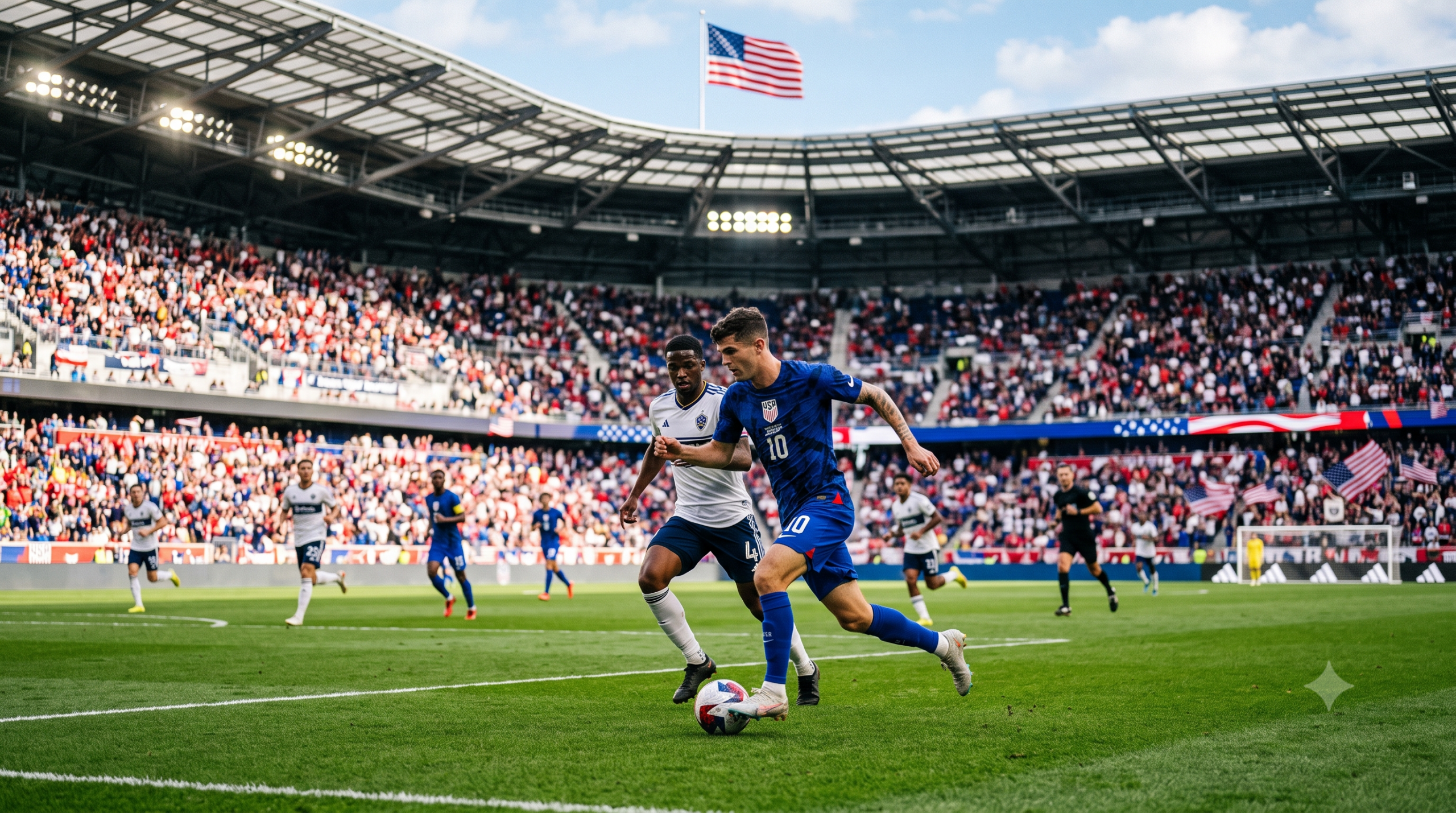
62.8 million viewers for one match. 6.8 million fans through the turnstiles. And one number that quietly suggests the job is not finished.
For thirty years the same sentence has been written about soccer in the United States: it is about to break through. On 19 July 2026 it finally did, and the margin was not close.
62.8 million Americans watched Spain beat Argentina 1-0 in the World Cup final at MetLife Stadium. The previous all-time high for any soccer telecast in the country was 26.7 million, set by the 2015 Women’s World Cup final. This was not an improvement on the record. It was a different order of magnitude.
The new record book for soccer in the United States
Here is every headline number from the tournament and the MLS season, set against the benchmark it replaced.
Soccer in the United States: the 2026 record book
Every headline number from the 2026 World Cup and MLS season, against the benchmark it replaced. Click the column headers to sort.
| # | Metric | 2026 | Previous benchmark | Change |
|---|---|---|---|---|
| 1 | Most-watched soccer telecast, all languagesSpain–Argentina final, FOX + Telemundo | 62.8M | 26.7M2015 Women’s World Cup final | +135% |
| 2 | Most-watched soccer telecast, English-languageSpain–Argentina final on FOX | 38.94M | 16.78M2022 final on FOX | +132% |
| 3 | World Cup average per match, FOX platforms104 matches, FOX / FS1 / Tubi | 7.74M | 3.59M2022 tournament | +116% |
| 4 | World Cup average per match, Telemundo / PeacockNielsen linear + Adobe streaming | 6.30M | 2.60M2022 tournament | +143% |
| 5 | World Cup average per match, both networksRank&Roll calculation | 14.04M | 6.19M2022 tournament | +127% |
| 6 | FOX telecasts averaging 15M+ viewersPer tournament | 11 | 22022 tournament | +450% |
| 7 | Telemundo / Peacock telecasts averaging 6M+Per tournament | 42 | 22022 tournament | +2,000% |
| 8 | Total tournament attendance104 matches in 2026 vs 52 in 1994 | 6,810,966 | 3,587,5381994 World Cup, USA | +90% |
| 9 | Streaming share of Telemundo’s audiencePeacock and Telemundo digital | 48% | 30%2022 tournament | +18 pp |
| 10 | MLS average weekly live match viewersApple TV + linear, first 3 months | 7.9M | 4.9M2025 season | +62% |
Sources: Sports Media Watch and Sports Video Group on Nielsen and Adobe Analytics data; FIFA official attendance; MLS Communications (May 2026). Note: row 5 is our own calculation from the two published network averages; row 10’s benchmark is derived from the stated +62% year-on-year change. FOX figures include pre-match coverage; Telemundo figures are match-window only.
The Seinfeld benchmark
The comparison that lands hardest is not with other soccer. FOX’s match window averaged 42.5 million and Telemundo added 23.9 million, for a combined 66.4 million — the largest US television audience outside NFL games and news events since the series finale of Seinfeld in 1998 (76.3 million).
On FOX alone the match beat Game 7 of the 2016 World Series (40.9 million), making it the biggest non-NFL sporting event since the 1994 Lillehammer Olympics. Since January 2024, exactly four telecasts have drawn a larger combined US audience: three Super Bowls and the September 2024 presidential debate.
The half of the audience nobody counts properly
Telemundo and Peacock averaged 6.3 million viewers per match, up 143% on 2022, and delivered 23.9 million for the final — the most-watched soccer match in Spanish-language media history. Here is the detail that matters: streaming accounted for 48% of that audience, up from 30% four years ago.
Nielsen does not measure NBCUniversal streaming. So the official Nielsen figure for the final on Telemundo was 10.0 million, while the real number was 23.9 million once Adobe-tracked streaming was added. Most published “TV records” therefore understate what actually happened. The Spanish-language audience is not a footnote in American soccer — it is close to a third of it.
The stadiums told the same story
A record 6,810,966 fans attended the 104 matches, nearly double the 3,587,538 of USA 1994 — though with 52 more matches to fill, that comparison flatters 2026. FIFA Fan Festivals drew another 5.5 million visitors, and FIFA puts the tournament’s global economic footprint at roughly $40.9 billion. Consumer spending across the 16 host cities rose 6.3% year-on-year, driven by a 16.7% jump in visitor spending.
One curiosity worth keeping. The strongest local television market for the whole tournament was not New York or Los Angeles. It was Kansas City, with a 4.89 rating, ahead of Boston, Austin, San Francisco and Dallas.
The part that is not settled
Now the caveat, because a ranking without one is marketing. MLS averaged 22,109 fans per match through May 2026 — excellent, and yet only the second-best mark in league history. The record still belongs to 2024. Domestic attendance did not accelerate because a World Cup was coming.
Television is a different story: MLS averaged 7.9 million weekly live match viewers across Apple TV and linear partners, up 62% year-on-year, and the league now has the youngest average fan in US men’s professional sport at 39.6 years old. Meanwhile, 13 MLS cities served as World Cup host markets.
1994 also produced a boom. It took MLS a decade to convert it into a stable league. The open question is whether a 39-day tournament that produced nine of the eleven biggest soccer audiences in English-language US history leaves anything behind once the flags come down. MLS resumed on 16 July; those numbers are the real test.
What to take away
1. The ceiling was never the problem
The audience existed. It simply had never been given a men’s World Cup in its own time zones. Kick-offs in the afternoon and evening, rather than at breakfast, did an enormous amount of the work here.
2. Streaming carried the growth
Telemundo’s digital audience grew almost 300%, and streaming went from a third of its audience to nearly half. Any future measurement of soccer in the United States that leans on linear ratings alone will be measuring the wrong thing.
3. Conversion remains unproven
A record 62.8 million watched one match. MLS averages 22,109 people in a stadium. Between those two numbers sits the entire business case for the next decade of the sport in America.
| ▸ THE RANK&ROLL NUMBER 62.8 million. That is 2.4 times the old record, and more than any US telecast since 1998 that was not football or news. Soccer in the United States did not grow this summer — it changed category. |
Leave a Reply