
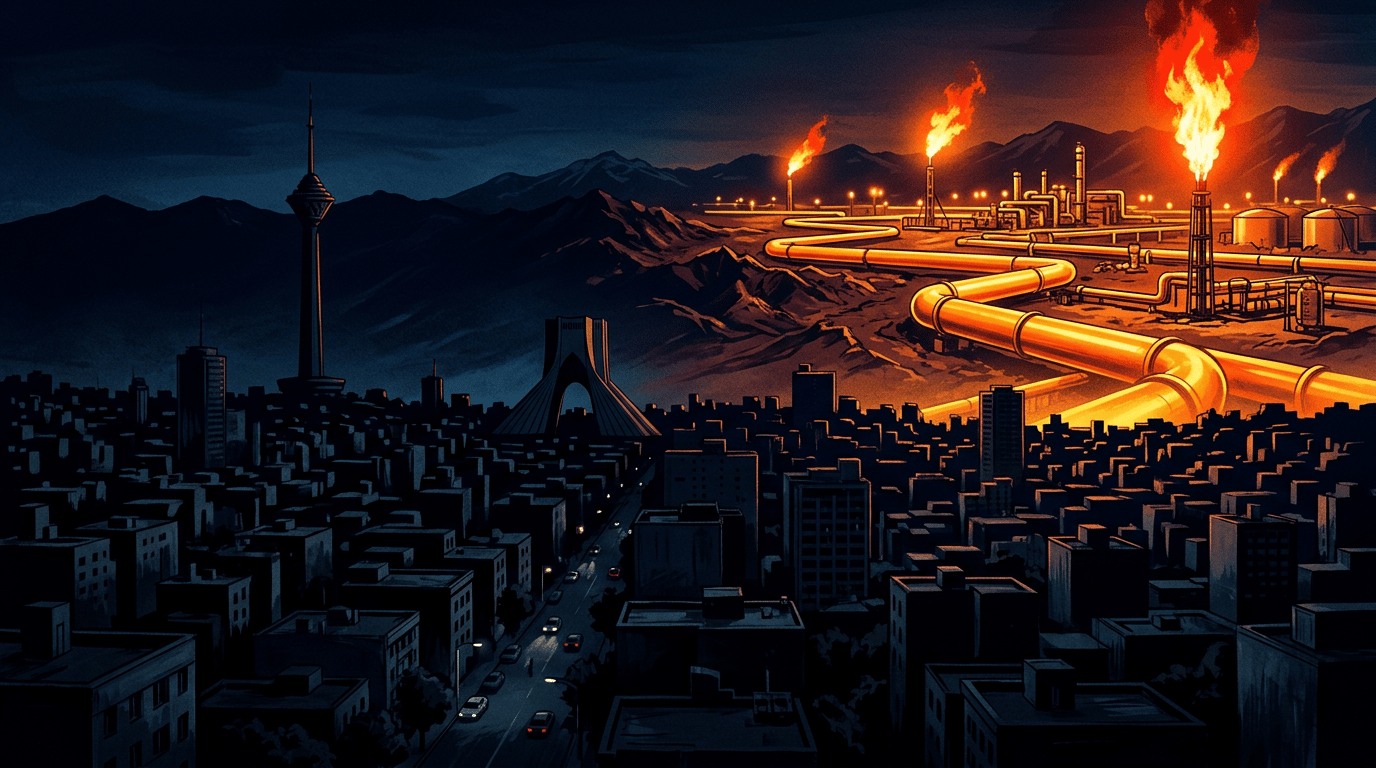
Today we’re looking at one of the most jaw-dropping paradoxes in global geopolitics. A country sitting on some of the largest energy reserves on earth — that can’t keep the lights on for its own citizens. Let’s talk about Iran 🇮🇷
First, the numbers that make Iran a superpower
Before we get to the crisis, let’s set the stage.
On paper, Iran should be an energy giant. It has more natural gas than almost any country on earth. It’s the fourth in the world for Oil Reserves It has 300 sunny days a year. It has wind corridors, mountains, and coastline perfectly suited for renewables. And yet…
A country living in the dark
Since February 2025, power goes out nationwide for 3 to 4 hours every day. Not in rural villages. Nationwide. Including Tehran. Iran faces a constant 20% electricity deficit, a 25% natural gas deficit, and severe shortages of petroleum products — including gasoline. Half of Iran’s industry has halted due to rolling blackouts. Here’s what that looks like in practice:
- 🏫 Schools open at 6am to finish before the blackouts
- 🔋At least 80 of the country’s 600 power stations have halted operations
- 🏭 Energy-intensive industries — steel, manufacturing, petrochemicals — are operating at less than half capacity
- 🏘️ In high-rise buildings, electricity cuts disable water pumps, leaving residents without running water for days
How is this possible?
Three main reasons. None of them are accidents.
- 1. Decades of underinvestment
Over 90% of Iran’s electricity is generated by thermal power plants, with some of the oldest running at efficiency rates as low as 20%. Renewables provide only 1% of Iran’s electricity. For comparison, the UAE — a much smaller country — is currently building the world’s largest solar farm. Iran devotes less than 1% of its national budget to renewable energy.
- 2. Sanctions + corruption = crumbling infrastructure
Due to aging and inefficient infrastructure, Iran loses during production and transmission 40% of the total household electricity and gas consumption. International sanctions have blocked the import of modern equipment. But sanctions alone don’t explain everything. The IRGC controls key energy assets through no-bid contracts, prioritizing political and military interests over the modernization of infrastructure.
- 3. Exporting energy while citizens go without
This is the detail that angers Iranians the most. Despite ongoing power shortages, Iran continued to export electricity, with a surge of nearly 92% in the first four months of 2023 compared to the same period the year before. And for close to a decade, Tehran provided Syria with 80,000–100,000 barrels of oil per day cost-free, while failing to provide sufficient fuel to its own citizens.
The one number to remember
1% — the share of Iran’s national budget invested in renewable energy, in a country with 300 sunny days a year and the world’s second-largest natural gas reserves.
What happens next?
There is no quick fix. Iran’s energy shortages will continue to limit economic activity for the foreseeable future. Without structural reform, foreign investment, and a diplomatic solution that eases sanctions, the lights will keep going out.
The paradox of Iran is not a natural disaster. It’s a policy disaster — built slowly, over decades, one bad decision at a time.
Enjoyed this issue? 📊 Follow Rank&Roll on X
More news? 📊 Follow Rank&Roll on X
Sources: Wikipedia (Iranian Energy Crisis) · Al Jazeera · Carnegie Endowment · Iran International · FDD Analysis · NIAC · Human Rights Institute (HRIUI) · 2025
Leave a Reply