
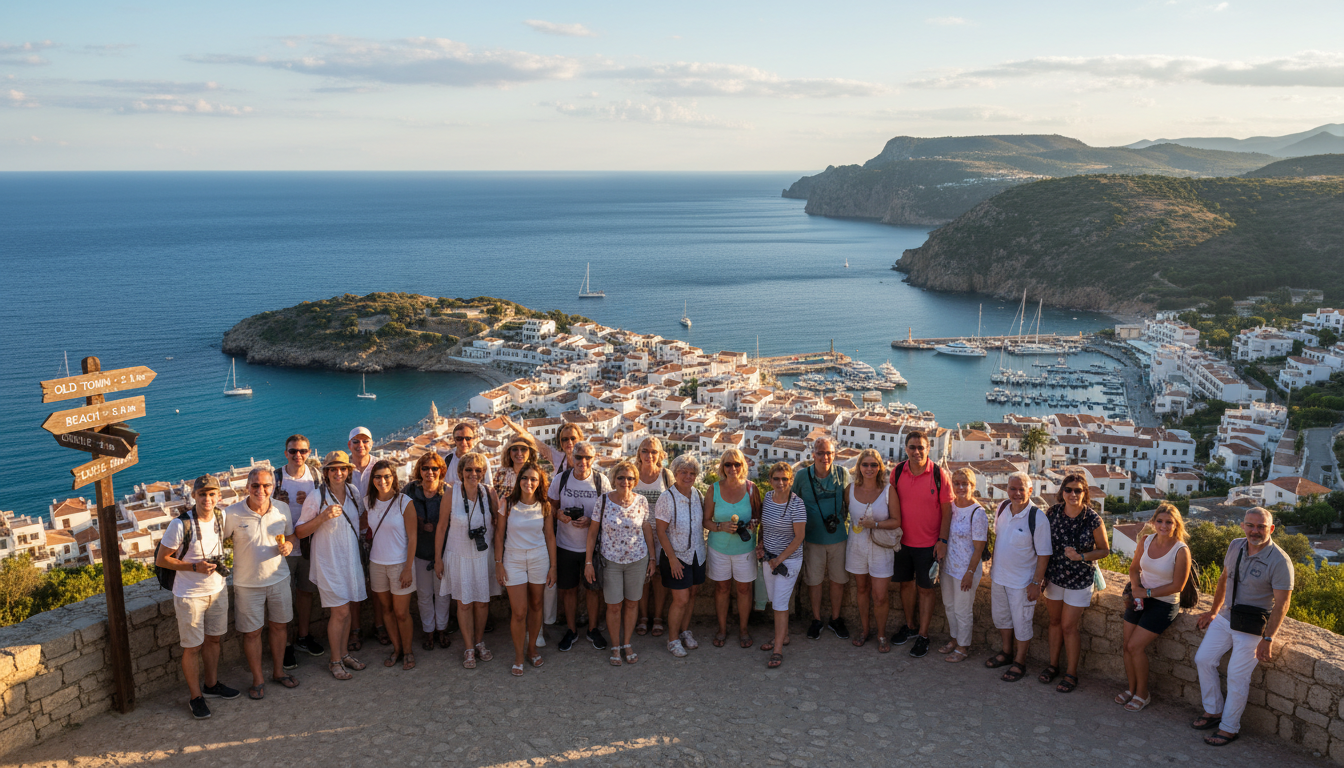
1.52 billion international tourists in 2025. This is not a futuristic scenario: it is the real figure published by UN Tourism in the World Tourism Barometer of January 2026. Global tourism has officially passed pre-pandemic levels, with almost 60 million more travellers than in 2024 and growth of +4% year on year.
For the world economy, this means a contribution of $11.7 trillion to global GDP (10.3% of the total, according to the WTTC) and 371 million jobs supported by the sector — more than the entire population of the United States.
And Italy? The Bel Paese confirms itself as a leading player: with 479.3 million tourist overnight stays in 2025 (+2.3% on 2024) and a contribution to GDP estimated at €237.4 billion, Italy ranks as the top European destination for summer tourism saturation rate.

In this article we analyse the most up-to-date data: the most visited countries in the world, the state of tourism in Italy, arrival flows by country of origin and the future trends that will shape the sector to 2030 and beyond.
👉 you might also like: is Finland the happiest country in the world?
The Most Visited Countries in the World: The 2024 Top 10
According to UNWTO data updated to 2024 (the latest year with a complete ranking), the global tourism map confirms some established superpowers, but also holds some interesting surprises.
Tourist Flows to Italy by Country of Origin
Who visits Italy? Data from ENIT and from the Visit Italy Tourism Observatory (presented at BIT 2026) draws a clear map of the key markets. Here is the ranking of the main countries by spending and air arrivals:
🇩🇪 Germany Remains the Top Market for Spending
With €7.5 billion spent in the first 9 months of 2025, German tourists confirm themselves as the most generous in absolute terms. They favour seaside, lakeside and mountain tourism (South Tyrol, Lake Garda, Tuscany), with long stays and high loyalty.
🇺🇸 The USA: Highest Average Spend
American tourists spend an average of €723 per person, concentrating on premium experiences: fashion, luxury, gastronomy and art cities (Rome, Florence, Venice, the Amalfi Coast). Total spending reached €5.3 billion in the first 9 months of 2025.
🇬🇧 The United Kingdom Leads on Air Arrivals
With 1.6 million air arrivals (15% of the international total), the United Kingdom is the leading market by volume of passengers arriving in Italy. British visitors also show the highest satisfaction level (85.35/100), appreciating the food and restaurant offer in particular.
🌏 Emerging Markets: Asia and Latin America
Worth watching is the growth of South Korea and Brazil, already present in the Easter 2025 flows with 2.2% and 2.6% of air arrivals respectively. For 2026, ENIT expects a significant recovery of the Asian market.
Future Tourism Trends: What to Expect by 2030
Looking only at current data is not enough. World tourism is undergoing a deep transformation. Here are the macro-trends that will define the sector in the coming years, according to analysis from the WTTC, UN Tourism and industry observers.
1. Sustainable and Responsible Tourism
The WTTC estimates that global tourism generated 6.5% of world emissions in 2023. Environmental pressure and protests against overtourism (Barcelona, Venice, Amsterdam) are pushing governments and operators towards more sustainable models. In Italy, the Ministry of Tourism’s strategy focuses on spreading demand outside peak season and on promoting villages and inland areas: more than 2,600 villages with tourism potential already generate flows comparable to those of five major art cities.
2. Experiential and Food-and-Wine Tourism
Travellers are increasingly looking for authentic experiences. The 2025 Food and Wine Tourism Report reveals that between 60% and 74% of European tourists have travelled for reasons connected to food and wine in the last three years. The most attractive Italian regions? Tuscany, Sicily, Sardinia and Apulia. The most searched wine-tourism destinations: Chianti, Etna and Montepulciano.
3. Artificial Intelligence and Digitalisation
AI is revolutionising trip planning, offer personalisation and hotel revenue management. The Italia.it portal reached 22.7 million visits in 2025, the leading official tourism portal in Europe. OTAs (Booking, Expedia, Airbnb) remain dominant with 42% of bookings, but 27% of travellers prefer to book direct.
4. Major Events as Catalysts
The 2025-2026 Jubilee and the Milan-Cortina 2026 Winter Olympics are powerful accelerators of visitor flows. 50% of operators in Lazio already report higher tourist inflows linked to the Holy Year. For Milan-Cortina, booking rates reach 60-85% expected occupancy in Cortina for February 2026.
5. Global Forecasts: +3/4% a Year to 2035
WTTC projections indicate that by 2035 the Travel & Tourism sector will contribute $16.5 trillion to world GDP (11.5% of the total), with an average annual growth rate of 3.5%, higher than the growth of the overall economy (2.5%). UN Tourism forecasts growth in international arrivals of +3/4% in 2026.
👉 you might also like: which are the oldest and youngest nations in the world?
Conclusion: Tourism as an Economic and Cultural Engine
The data speaks clearly: tourism in the world and in Italy has not only recovered pre-pandemic levels, it is redefining its own records. With 1.52 billion global tourists, almost 480 million overnight stays in Italy and international spending approaching $2 trillion, the sector confirms itself as a pillar of the world economy.
Italy, in particular, is playing a leading role: first in Europe for regional tourism competitiveness, with a steadily growing international component and an offer ranging from art cities to villages, from the mountains to food-and-wine tourism.
The challenge for the coming years? Managing growth sustainably, spreading flows across time and space, and using technology to improve the traveller’s experience.
Did you enjoy this analysis? Follow us on rank-roll.com and on Instagram @rankroll87 to stay up to date on data, rankings and trends from around the world. Leave a comment below: what was your favourite destination of 2025?rotagonista: prima in Europa per competitivita turistica regionale, con una componente straniera in costante crescita e un’offerta che spazia dalle citta d’arte ai borghi, dalla montagna al turismo enogastronomico.
La sfida per i prossimi anni? Gestire la crescita in modo sostenibile, distribuire i flussi nel tempo e nello spazio, e sfruttare la tecnologia per migliorare l’esperienza del viaggiatore.
Ti e piaciuta questa analisi? Seguici su rank-roll.com e su Instagram @rankroll26 per restare aggiornato su dati, classifiche e trend dal mondo. Lascia un commento qui sotto: qual e la tua destinazione preferita del 2025?
Leave a Reply